Learning and Employment Records (LERs) are quickly moving from concept to infrastructure—reshaping how learning, skills, and work are documented, verified, and exchanged. As adoption accelerates across education, workforce systems, employers, and government, the ecosystem has become both more promising and more difficult to understand.
The LER Ecosystem Report exists to make the ecosystem legible end-to-end. It explains the basics, maps the full landscape of participants and roles, highlights where the field stands today and where it’s headed, and gives leaders a practical foundation to develop a strategy for what comes next.
This report represents the fourth year of ongoing research into the LER ecosystem. Across four editions, the research has been informed by interviews and input from more than 100 experts spanning education, workforce development, government, standards bodies, and technology providers. The ecosystem maps and infographics included in this report build on years of iterative analysis, refinement, and validation.
A field guide for anyone building, funding, governing, or operating the infrastructure between learning and work.
“Learning and Employment Records can feel complex at first, especially for organizations new to the space. This report provides a clear, accessible introduction to what LERs are, why they matter, and how they are being used in real-world systems today. Importantly, it also highlights the growing adoption and scale of LERs across the ecosystem—and encourages readers not just to observe this shift, but to become proactive participants in shaping what comes next.”
— Taylor Hansen, Principal, Achievement Wallet Strategy & Ecosystem, Western Governors University
The LER Ecosystem Report is organized to reflect how learning and employment data moves through real-world systems—from the point where achievements and experiences are formally recognized, to how individuals take control of those records, to how they are used to create value across education, hiring, workforce development, and government.
Rather than focusing on a single use case or sector, the report takes an end-to-end view of the ecosystem. It shows how different categories of organizations interact, how data flows between systems, and how open standards enable records to remain portable, verifiable, and controlled by individuals as they move across contexts.
To make these dynamics visible, the report uses ecosystem maps, category breakdowns, and practical examples that illustrate how Learning and Employment Records support discovery, decision-making, and mobility. Together, these views help readers understand not only how the ecosystem works today, but where friction remains and where new capabilities are emerging.
The full framework, diagrams, and examples are explored in detail in the report.
"At Strada, we know that people lose time, credit, money, and trust in systems when learning can’t move across a fragmented postsecondary education and work landscape. Learning mobility requires shared, trusted infrastructure to empower individuals to control and use their own achievement information. This is the next frontier for education and workforce data, and this report helps show us how to get there."
— Jon Furr, SVP & Chief Data Ecosystem Officer, Strada Education Foundation
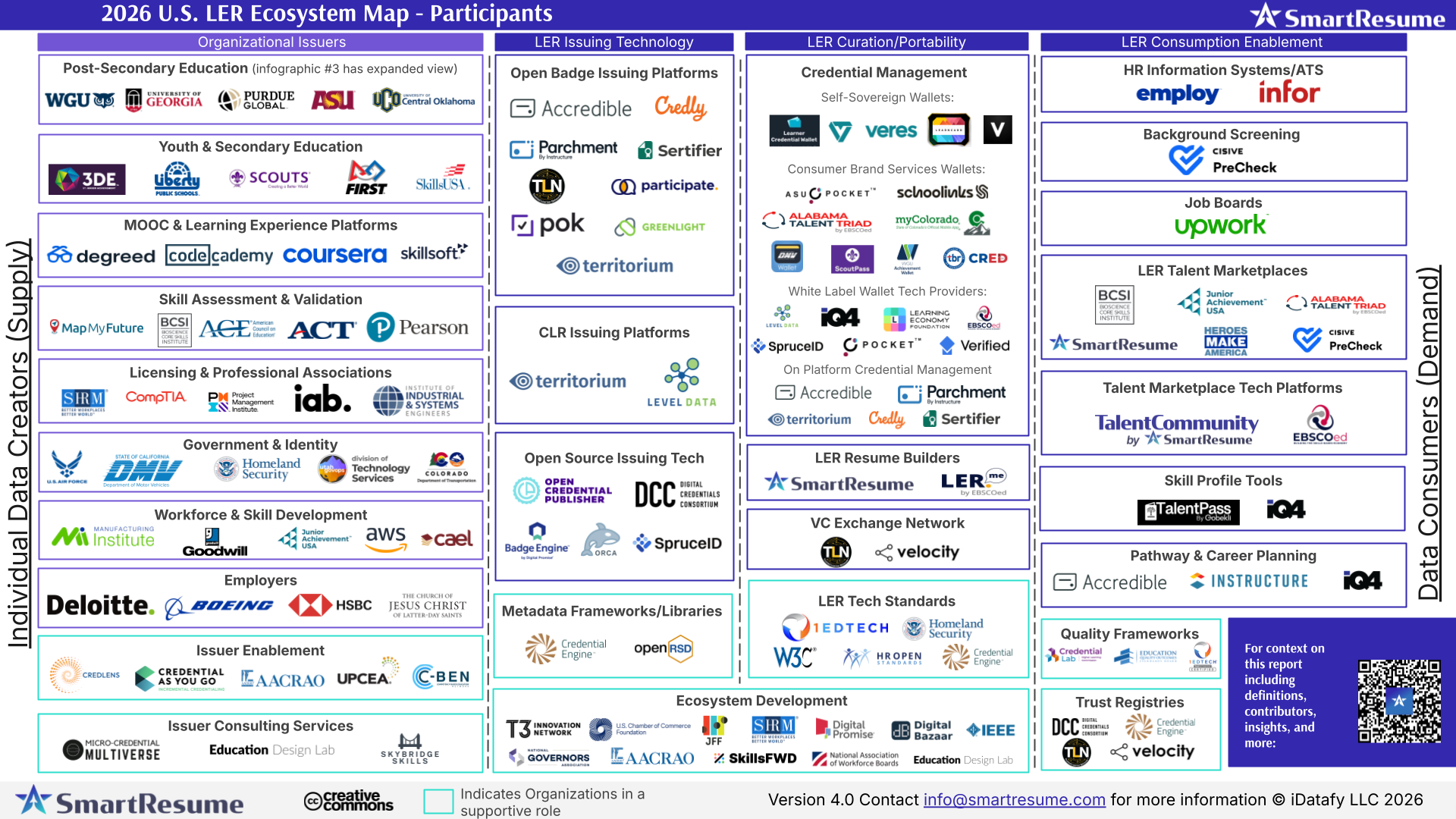
The ecosystem maps and infographics included in this report are intended to be used as reference tools to support understanding, discussion, and decision-making across the LER ecosystem.
To encourage responsible reuse, the visuals are shared under a Creative Commons license. We ask that they be preserved in their original form and that attribution include a link back to this report when they are shared. Because the complexity of the ecosystem cannot be fully captured in a single visual, the report provides additional context, definitions, and analysis to clarify and extend what is shown in the maps.
The organizations represented reflect the research team’s current understanding of the participants materially contributing to the development and adoption of Learning and Employment Records. As the ecosystem continues to evolve, this report will be updated in future editions, and feedback from the field is welcome.
The LER Ecosystem Report is designed to support a wide range of stakeholders navigating Learning and Employment Records. Different readers use this report in different ways, depending on their role and objectives.
Use this report to understand the full Learning and Employment Record ecosystem, identify infrastructure gaps, and inform policy, funding, and procurement decisions related to workforce development, education, and human services.
Use this report to see how Learning and Employment Records connect learning to employment, understand the standards and technologies involved, and design or evolve credentialing and talent-development strategies.
Use this report to understand how LER data flows into hiring and workforce systems, explore emerging use cases for skills-based hiring, and track where credential-based data is beginning to influence recruitment and advancement.
Use this report to identify leverage points across the ecosystem, understand where adoption and momentum are building, and spot gaps, overlaps, and opportunities for strategic investment and coordination.
Use this report to position your organization within the broader LER ecosystem, understand adjacent and complementary categories, and track standards, interoperability requirements, and market evolution.
The full report includes detailed diagrams, definitions, examples, and analysis to support each of these use cases.
"At the end of the day, interoperability doesn't mean much to employers unless it provides data they can actually trust and use. This report breaks down how LERs work across different standards and tech, making it a go-to guide for anyone actually building or using these tools."
— Jim Ireland, Executive Director, HR Open Standards Consortium
For the purposes of this report, the Learning and Employment Record (LER) ecosystem is defined as the organizations, technologies, and standards involved in issuing, managing, sharing, and consuming records of learning, skills, and employment.
The report focuses on the practical infrastructure required to make these records portable, verifiable, and useful at scale. This includes how data is issued by trusted organizations, controlled by individuals, moved between systems, and ultimately consumed by employers, education providers, workforce systems, and government agencies.
To make this ecosystem understandable, the report organizes participants into four macro-categories that reflect how value is created as LER data moves end-to-end:
Each macro-category is further broken down into sub-categories in the report, with definitions and examples to clarify the distinct roles different participants play. Together, these categories illustrate how Learning and Employment Records move from issuance to real-world use—and where strategic decisions must be made to enable scale.
Detailed definitions, sub-categories, and ecosystem maps are explored in the full report.
This report draws on interviews and input from leaders across the Learning and Employment Record ecosystem, spanning education, workforce development, government, standards bodies, and technology providers. Their insights informed the report’s structure, analysis, and interpretation of where the ecosystem stands today and where it is headed.
Research for this report surfaced a set of clear signals indicating that Learning and Employment Records are moving from experimentation toward durable infrastructure. While adoption is uneven, the direction of travel is becoming increasingly difficult to ignore.
Across interviews and ecosystem analysis, several themes consistently emerged:
The full report explores these trends in detail, along with additional signals, examples, and implications for strategy. Together, they point to a future in which Learning and Employment Records serve as shared infrastructure connecting learning and work at scale.
The Learning and Employment Record ecosystem spans a wide range of organizations that play different roles in how learning, skills, and employment data is created, managed, shared, and used. To make this complexity understandable, the report groups participants into clearly defined categories based on the function they serve within the ecosystem.
These definitions are not intended to be exhaustive or permanent. Rather, they reflect the research team’s current understanding of how roles are emerging, converging, and differentiating as Learning and Employment Records move toward broader adoption.
Within the report, each category and sub-category is defined in detail, with examples to illustrate how different organizations contribute to the end-to-end lifecycle of LER data—from issuance, to individual control, to real-world use across education, hiring, workforce development, and government.
Together, these definitions provide a shared vocabulary for discussing the ecosystem and help readers interpret the ecosystem maps, trends, and signals explored throughout the report.
Full definitions, sub-categories, and participant examples are provided in the report.
In addition to analysis and ecosystem mapping, the LER Ecosystem Report includes a curated set of implementation resources identified and shared by contributors during the research process.
These resources reflect the tools, frameworks, standards, and reference materials that practitioners across education, workforce development, government, and technology are actively using as they design, implement, and scale Learning and Employment Record initiatives. Rather than presenting a generic reading list, the report surfaces resources recommended by people doing the work on the ground.
Together, these materials make the report more than a snapshot of the ecosystem. They turn it into a practical toolkit—providing readers with trusted starting points for learning, planning, and action as they develop LER strategies of their own.